
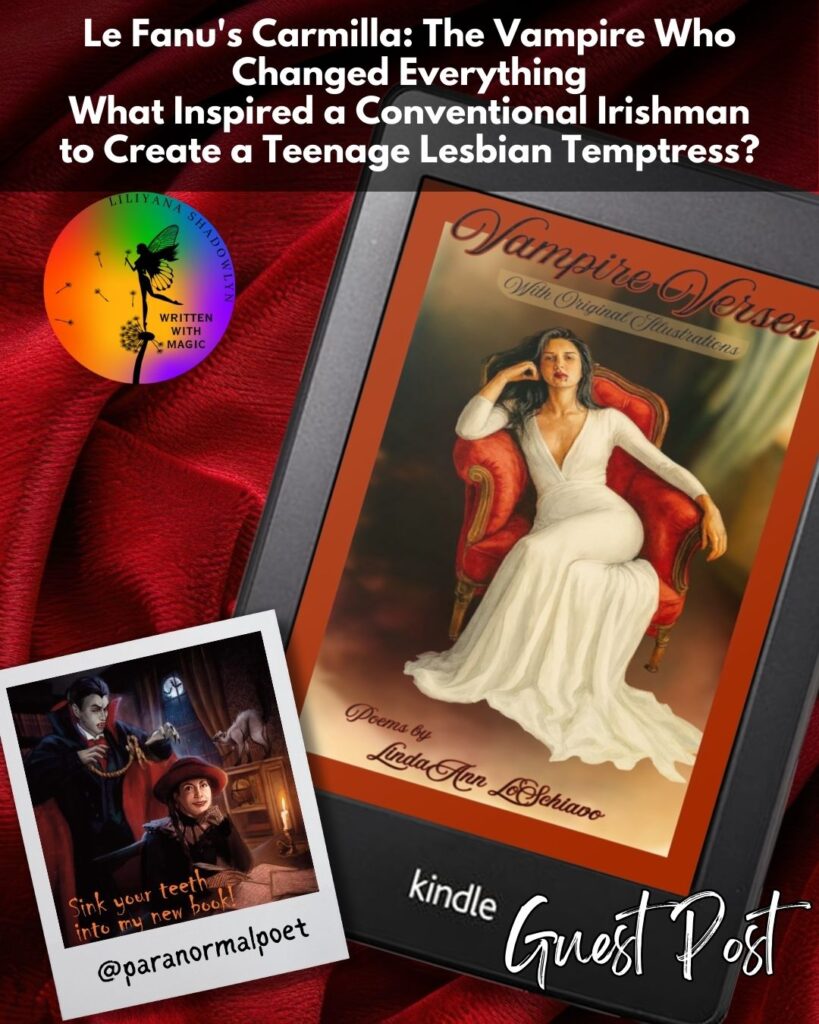
Vampire Verses
Vampire Poetry

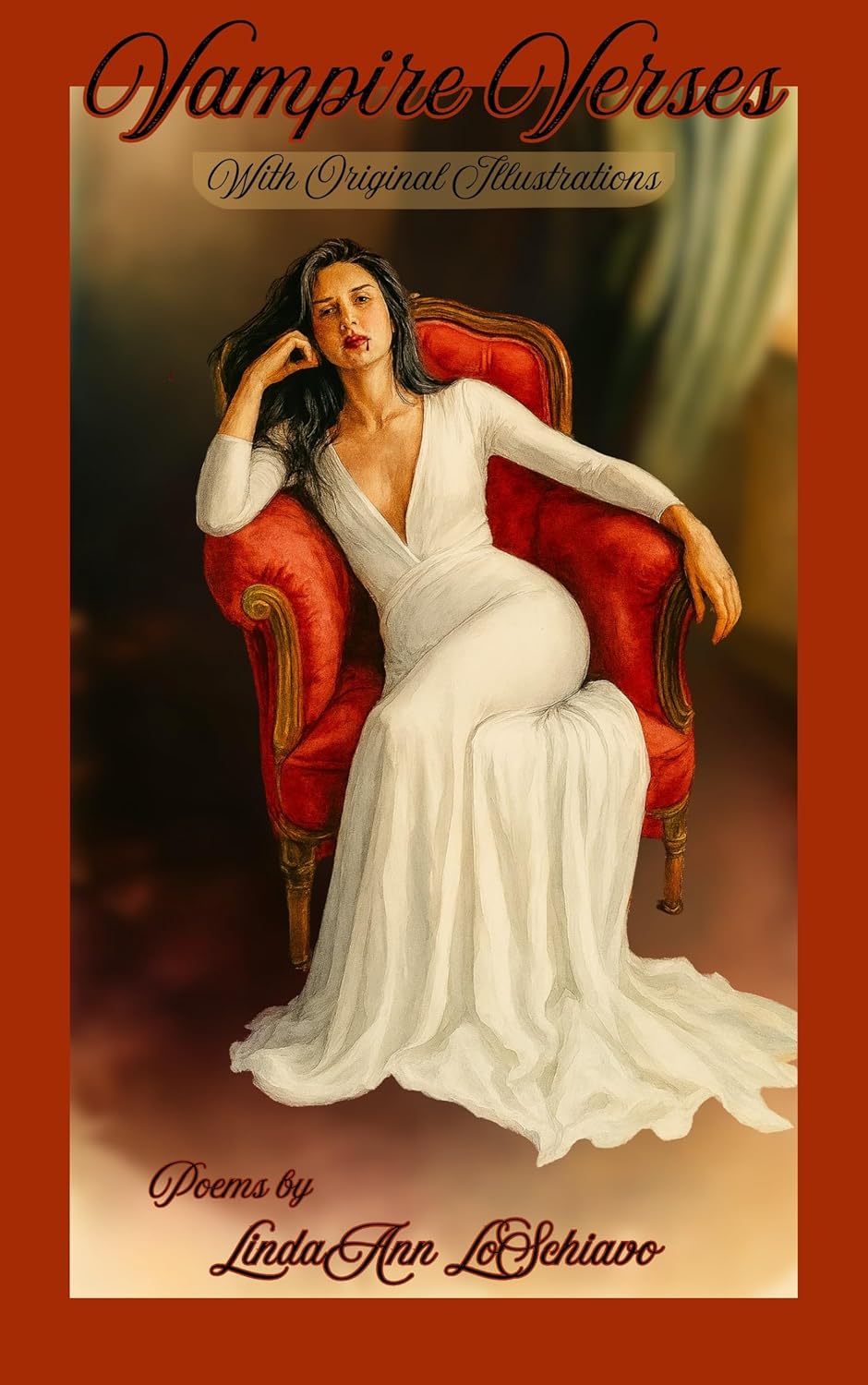
by LindaAnn LoSchiavo
“Vampire Verses” explores the seductive mystique of the shadow sphere and savors the forbidden allure of encounters with the supernatural — illustrated by spooky full-page artwork.
For lovers of Gothic poetry and vampire lore, this collection captures what makes these immortals irresistible: their paradoxical existence where death becomes a gateway to living more intensely.
GUEST POST
Le Fanu’s Carmilla: The Vampire Who Changed Everything
What Inspired a Conventional Irishman to Create a Teenage Lesbian Temptress?
Long before Bram Stoker’s “Dracula,” Irish writer J. Sheridan Le Fanu introduced readers to something far more unsettling: a beautiful, melancholic teenage vampire named Carmilla. Published in 1872, this novella stands as a Gothic masterpiece that deserves recognition beyond its role as one of Count Dracula’s models.
A Departure from Convention
Le Fanu’s earlier work typically featured corrupt aristocratic men as villains—judges, earls, and demon lovers. Carmilla represented something entirely different. Rather than a haughty noblewoman, she’s portrayed as a sluggish, depressed loner desperate for connection. She exhibits symptoms that modern readers might recognize as borderline personality disorder: demanding affection when rejected, withdrawing when it’s offered. This psychological complexity was revolutionary for vampire fiction.
An 1843 novella attributed to Le Fanu, “Spalatro: From the Notes of Fra Giacomo,” featured a necrophiliac obsessed with an undead blood-drinking woman—an early sketch of what would become his most famous creation. But Carmilla herself emerged from deeper literary roots.
Romantic Foundations
Le Fanu drew heavily from Romantic poetry. Samuel Taylor Coleridge’s unfinished “Christabel” presented Geraldine, a mysterious woman taken into a virtuous family’s home, displaying supernatural signs and an undefined terrible mark on her body. John Keats’ poem “La Belle Dame Sans Merci” offered another model: a cruel fairy queen who lures men into her cave, leaving them stupefied by unrequited passion.
Neither character was explicitly vampiric, but both introduced powerful women with sexual autonomy—a concept that defied Victorian expectations. This foundation allowed Le Fanu to craft something genuinely subversive.
Layers of Meaning
“Carmilla” functions simultaneously as psychological study, political allegory, and social critique. The story takes place in Styria, in rural Austria, but scholars have long recognized it as a coded commentary on Victorian Ireland. Laura’s father—an English expatriate refusing to assimilate into the local Catholic, agrarian culture—mirrors the Anglo-Irish aristocracy’s relationship with their adopted homeland.
In this reading, Carmilla represents the seductive danger of English nobility, which charmed the Anglo-Irish elite while exploiting vulnerable Irish peasants. Le Fanu, himself part of this Tory class, uses the vampire as metaphor for toxic political alliances: Laura’s father ignores every warning sign about Carmilla because of her impressive credentials and the prestige she offers. Just as his contemporaries blamed Ireland’s Great Famine on anything except their beloved aristocracy, Laura’s father refuses to see the monster before him.
The novella also explores class through Carmilla’s hunting methods. She quickly throttles and desanguinates peasant girls but slowly seduces noblewomen like Laura—a distinction scholars have interpreted as commentary on how sexual violence operated differently across social strata in Victorian society.
The Queer Question
“Carmilla” has become a touchstone for queer literary studies, though not in any straightforward way. The novella doesnot present a loving, consensual relationship between equals. Carmilla is genuinely predatory: she touches Laura without permission, makes possessive threats, and manipulates her victim’s emotions. She embodies toxic relationship patterns regardless of gender.
Yet Le Fanu’s treatment of his queer antagonist shows surprising empathy for a Victorian-era horror story. Carmilla is pitiable and lonely, seemingly capable of genuine love despite her destructive nature. She appears driven more by addiction and isolation than by malice. Her poignant backstory reveals she was turned into a vampire against her will by the ghost of a suicide and suggests that she was possibly trafficked by the woman posing as her mother. Some scholars read “Carmilla” as an allegory for prostitution—a sex worker forced to recruit Laura into the profession.
Modern queer theorists have found in Carmilla a literary martyr whose vampirism results from societal repression. Unable to express her desires openly in a patriarchal Victorian world, she has no choice but to become monstrous. Her execution by the cold, clinical Baron Vordenburg—described with notable distaste by the young narrator Laura—leaves readers uncomfortable in ways that transcend simple homophobia.
A Literary Legacy
What makes “Carmilla” endure is its refusal of easy answers. Laura never fully rejects her complicated feelings for Carmilla, even after understanding what she was. The threat isn’t entirely vanquished with Carmilla’s death—the novella suggests that “larger forces” remain, that the past can never be fully purged.
Le Fanu crafted something more psychologically sophisticated than most vampire fiction that followed. Where “Dracula” would become a more straightforward battle between good and evil, Carmilla lingers in ambiguity. She’s simultaneously victim and predator, genuinely affectionate and dangerously manipulative, worthy of both sympathy and fear.
The novella’s enduring power lies in this complexity—and in Le Fanu’s willingness to use Gothic horror as a vehicle for examining uncomfortable truths about desire, power, class, gender, and the seductive nature of beautiful monsters. “Carmilla” may have inspired “Dracula” – but she remains the more psychologically interesting vampire: not a distant aristocratic threat, but an intimate predator who genuinely seems to love the friend she’s destroying.
In our current era of morally complex vampires, from Anne Rice’s tormented immortals to contemporary paranormal romance, Carmilla stands as the original: a monster we can’t help but feel for, even as we recognize the necessity of her destruction. That contradiction—between sympathy and horror, attraction and repulsion—is what makes Le Fanu’s creation a Gothic masterwork that transcends its Victorian origins.
. . . . . . . . . . .
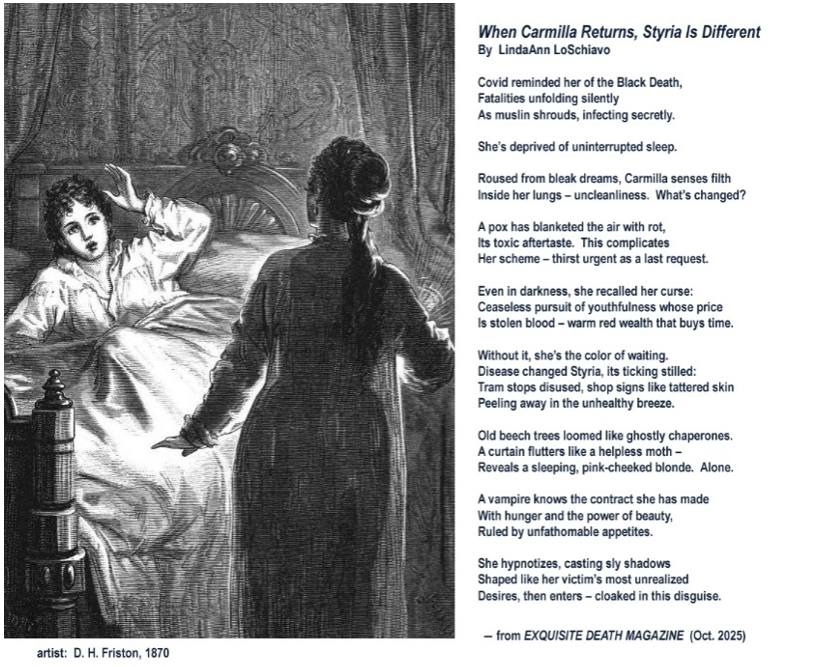
Author’s note: There is no doubt that Bram Stoker influenced my new collection “Vampire Verses” (Twisted Dreams Press, November 2025). But Le Fanu’s fingerprints are evident as well. My poem “When Carmilla Returns, Styria Is Different” ushers the lesbian temptress into the modern era by having her react to the COVID lockdown.

LEARN MORE

ABOUT THE AUTHOR
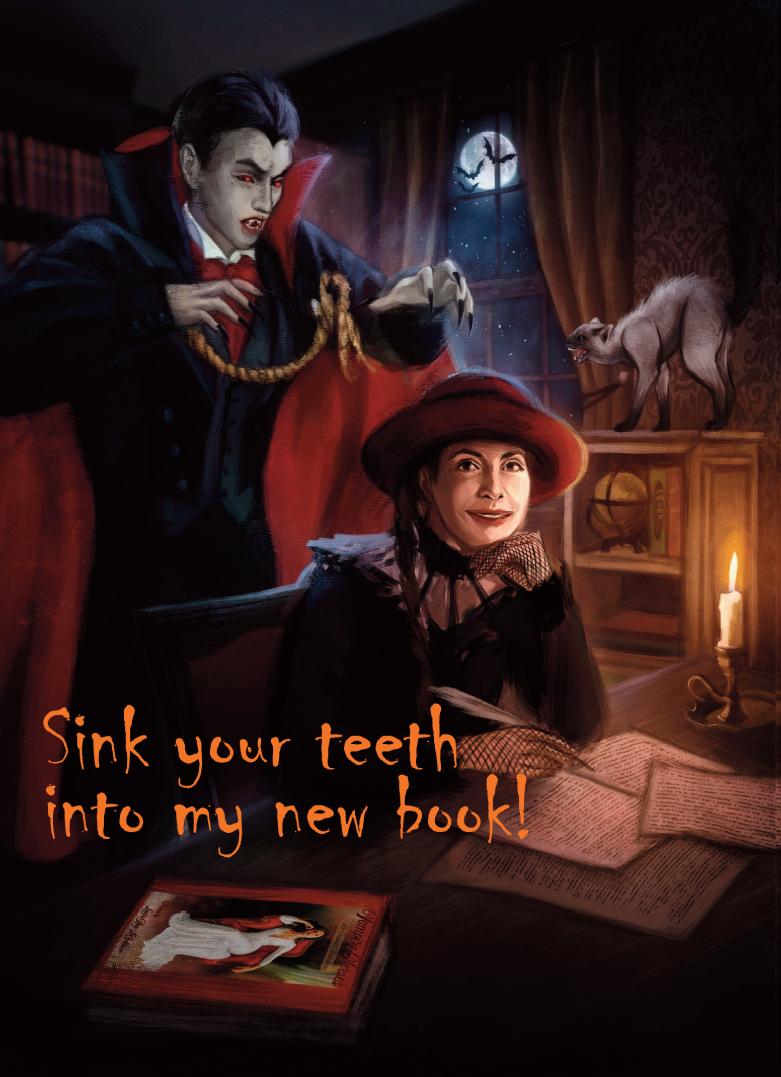
Native New Yorker and award-winner, LindaAnn LoSchiavo is a member of British Fantasy Society, HWA, SFPA, and The Dramatists Guild.
Titles published in 2024: “Always Haunted: Hallowe’en Poems” [Wild Ink], “Apprenticed to the Night” [UniVerse Press], and “Felones de Se: Poems about Suicide” [Ukiyoto].
Forthcoming: “Cancer Courts My Mother” [Prolific Pulse Press, 2025].
Book Accolades earned: Elgin Award for “A Route Obscure and Lonely” and Chrysalis BREW Project’s Award for Excellence for “Always Haunted: Hallowe’en Poems.”